
Range of motion tracked frame by frame
All industries
Physiotherapy & rehab
Objective adherence and form, between visits.
Clinical-grade movement assessment outside the clinic. Measure range of motion, movement quality and exercise adherence without reviewing hours of video.
Adherence verified, not self-reported
Compensation patterns flagged automatically
HIPAA-friendly. No video leaves the device
The challenge
Recovery happens between visits, where you cannot see it.
A clinician sees a patient an hour a week. The other 167 hours, the rehab programme is on its own. Adherence is unverified. Form is unverified. Compensation patterns develop quietly. By the next session, the trajectory has already drifted.
Adherence is a black box
Patients say they did the work. Most did some of it. A small share did none of it. Without an objective signal the clinician is reverse-engineering progress from outcomes.
Compensation goes unflagged
A patient guards the painful side and overloads the other. By the time the clinician sees it, weeks of reinforcement have shaped the new movement pattern.
Video review does not scale
Asking patients to record themselves and reviewing the footage works for one patient. It does not work for a caseload of 50. And the privacy cost of cloud video uploads is non-trivial.
How PoseFlow fits
Clinical-grade movement data, generated at home.
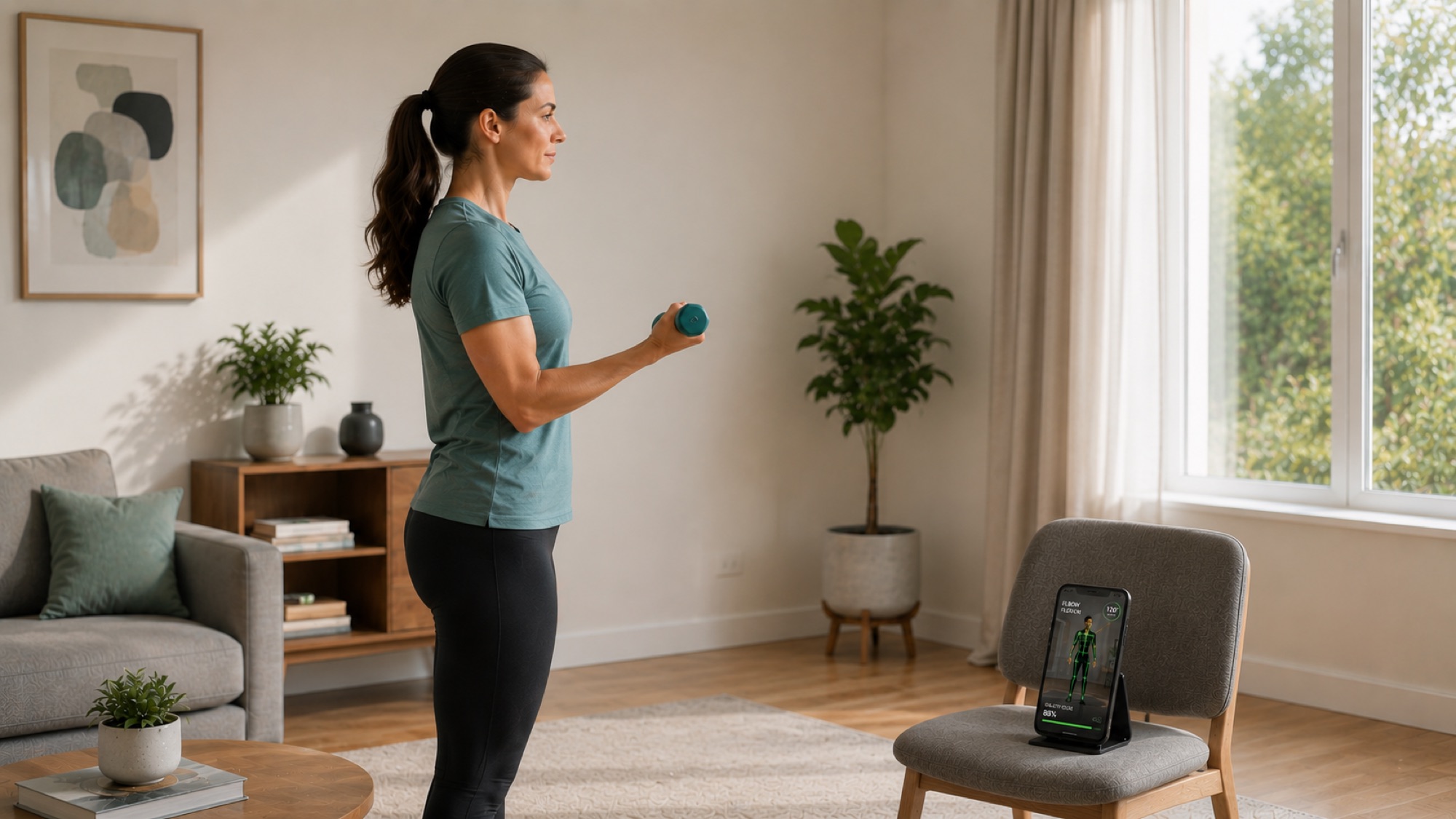
PoseFlow turns a patient's phone or tablet into a movement-measurement instrument. The exercise prescription becomes verifiable. The trajectory becomes visible between visits.
Range of motion, every rep
PoseFlow measures the joint angle, distance and ratio thresholds the clinician authored. Each rep is logged with its actual ROM, not a self-reported "done".
Adherence is a measurement
Sessions and reps land in your portal verified. Compliance reports replace patient-reported sliders with movement data the clinician can defend.
Compensation surfaced live
Form rules authored against the prescribed pattern flag bilateral asymmetry, hitched gait, hip drop. The patient sees the cue mid-set; the clinician sees the trend over the week.
Compliance without compromise
No video leaves the device. Only pose-coordinate data and aggregates reach your backend. HIPAA, GDPR and clinic-specific privacy policies pass without extra engineering.
Use cases
Where PoseFlow fits inside a rehab pathway.
Three deployment patterns we see across MSK platforms, post-op programmes and tele-rehab services.
01
Post-op shoulder programme
Day-1 home exercises focus on assisted ROM. PoseFlow tracks the cleared range, flags compensation through the trunk, and surfaces the ROM curve in the clinician portal. The 6-week review starts from data, not anecdote.
±3° Median ROM measurement variance vs goniometer
02
Chronic low-back maintenance
A long-tail patient does the same five exercises on most days. PoseFlow turns each session into a structured log: did the movement happen, at what quality, with what compensation. Drift surfaces before the patient feels it.
+38pp Adherence detection accuracy vs self-report
03
Tele-rehab follow-up
Between video appointments, PoseFlow runs the prescribed programme on the patient's tablet. The clinician sees the week ahead of the call. The call itself becomes about the pattern, not "how did the exercises go".
70 / 30 Call-time spent on data review vs status update
Integration
How PoseFlow fits into a rehab platform.
Most clinical platforms already have a patient app and a clinician portal. PoseFlow drops in as the measurement layer underneath the patient experience.
Read the technical docs- 01 Add the PoseFlow SDK to your existing patient mobile app.
- 02 Replace your video player with `TrackedMovementView` for the exercises you want measured.
- 03 Author each prescribed exercise as a `.pose` file in PoseFlow Studio (clinicians, not engineers).
- 04 Stream rep events and quality scores into your existing FHIR / proprietary data pipeline.
- 05 Surface aggregates in the clinician portal: ROM curves, adherence rates, flagged compensations.
Common questions
Physiotherapy FAQ
Is the measurement accurate enough for clinical use?
PoseFlow measures joint angles within a few degrees of a goniometer reading for the joints and views your authored exercises target. It is intentionally a screening + monitoring instrument, not a replacement for an in-clinic assessment.
How does it handle privacy?
No video leaves the device. PoseFlow extracts 33 anonymous body landmarks per frame, evaluates them against the prescribed pattern, and emits scalar measurements. Only those scalars (and your own aggregates) reach your backend.
Can clinicians author their own exercises?
Yes. PoseFlow Studio is the no-code authoring tool. Clinicians stand in front of a camera, name the phases of the movement, drop in the joint-angle thresholds, and save. The resulting `.pose` file plays back in your patient app unchanged.
Does it work for tele-rehab in low-bandwidth settings?
Yes. PoseFlow runs entirely on-device. Patients in rural or low-bandwidth settings still get full measurement and live form feedback. Only aggregate session data syncs when connectivity returns.
Talk to us
Ready to explore PoseFlow for physiotherapy & rehab?
We will prep a technical walkthrough tailored to your stack and your deployment timeline.
Ready to integrate
See how PoseFlow integrates into your product.
Each engagement starts with a technical walkthrough, tailored to your use case.