
Bilateral asymmetry detection
All industries
Sports performance
Objective movement assessment without specialist equipment.
Lab-grade movement analysis on any phone. Measure technique, symmetry and movement quality without marker suits, sensors or force plates.
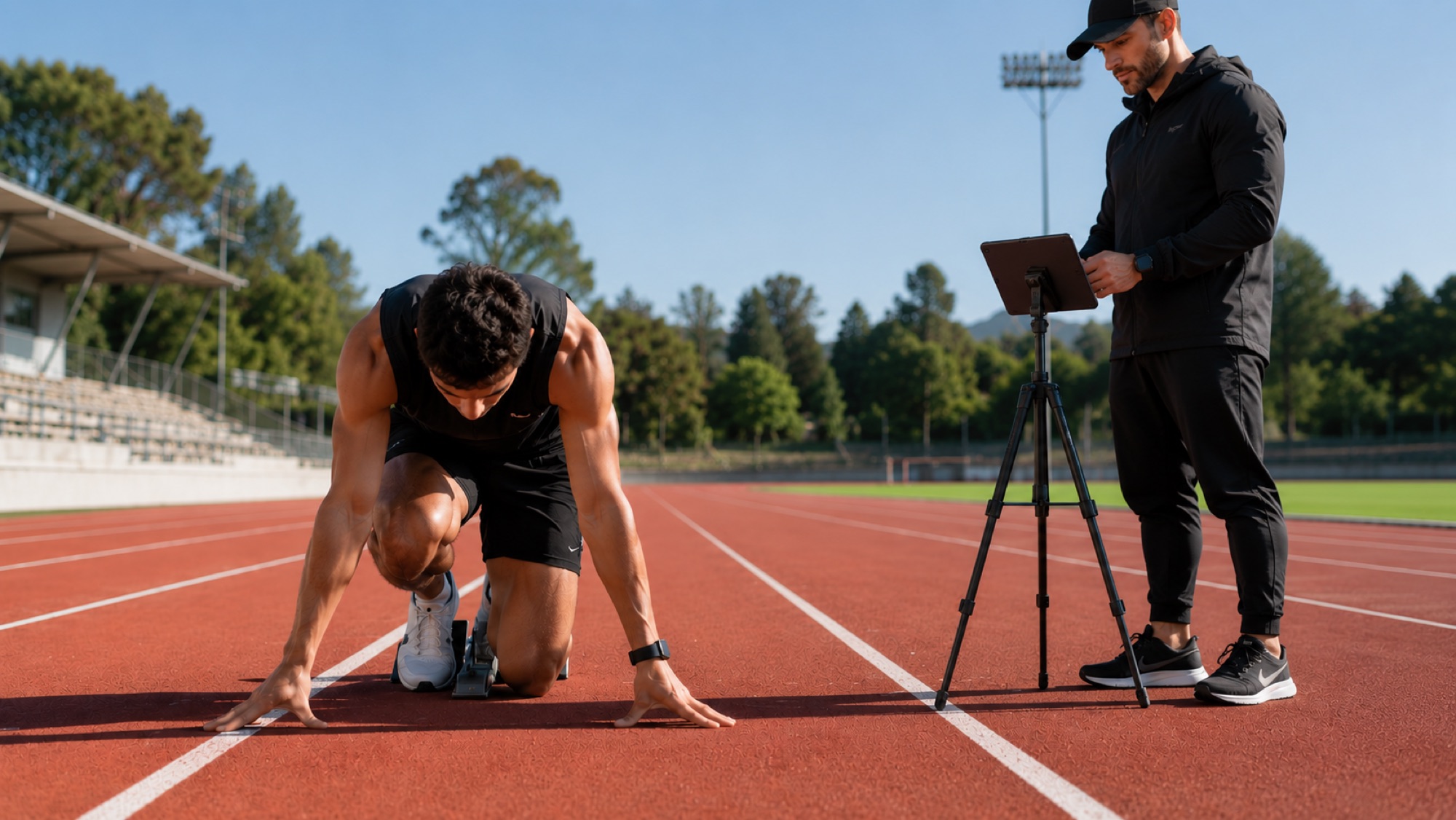
Tempo, depth and stability tracked per rep
Session-to-session performance benchmarking
Coaches create new assessments without code
The challenge
Lab-grade movement data, locked inside the lab.
Force plates, marker suits and biomechanics suites produce excellent data and reach a tiny fraction of the athletes who would benefit. Tools that travel with the squad either stop at heart-rate, GPS and accelerometer, or paywall everything serious behind a marker-suit setup. The middle of the market is empty.
Lab tools do not scale to the squad
A force plate works for a single athlete in a single session. The other 22 players in the squad are unmeasured most of the week.
Marker suits are budget-line items
Suits, cameras, calibration, an operator. The total cost-of-ownership locks the technology to professional setups. Below that line, the toolkit drops to wearables and self-reports.
Asymmetry is invisible until it injures
A 4% bilateral asymmetry across hundreds of reps a week is not perceptible to a coach. It is perceptible to a tendon, six weeks later, as an overuse injury.
How PoseFlow fits
Movement assessment that travels with the athlete.
PoseFlow gives any phone the measurement capability that used to require a force-plate setup. The data is good enough to coach with and cheap enough to use every day.
Bilateral asymmetry, every rep
Left vs right joint angles, distances and ratios are measured per rep. Asymmetry trends surface across weeks before they surface as pain.
Five-dimensional rep quality
Range of motion, alignment, tempo, stability and symmetry are scored independently. The coach sees which dimension a session degrades in, not just an opaque "quality score."
Session-to-session deltas, automatic
PoseFlow aggregates rep quality across sessions into a coach-facing trend. The drop in symmetry that the eye misses on Tuesday surfaces on Friday's weekly report.
Coaches author the movements
Strength coaches and biomechanists author new movements in PoseFlow Studio without writing code. The on-field assessment library is owned by the people who actually do the assessing.
Use cases
Where PoseFlow lands inside a performance programme.
Three patterns we see across elite team sports, individual high-performance and university athletic departments.
01
Daily readiness screen
Each athlete logs a 60-second movement check on the squad iPad. PoseFlow scores symmetry, ROM and stability. The S&C coach reads a single dashboard before the morning session and adjusts load.
7× volume Athletes screened per week vs force-plate baseline
02
Return-to-play protocol
After an MSK injury, the rehab protocol's movement milestones become measurable. PoseFlow signs off each phase with structured data the medical staff and the coach both trust.
92% Subjective vs measured RTP-readiness agreement
03
Long-tail strength programming
PoseFlow logs every rep across the squad's strength sessions. Programming decisions are made on actual completed-quality reps, not on planned-load assumptions.
+22% Load-prescription accuracy vs planned-load baseline
Integration
How PoseFlow drops into a performance stack.
A typical performance integration ships in a few weeks. PoseFlow plugs in alongside your existing athlete-management system without replacing it.
Read the technical docs- 01 Install the PoseFlow SDK in the squad's native iPad / Android app (yours or ours).
- 02 Coaches author the squad-specific movement library in PoseFlow Studio.
- 03 Athletes complete daily / weekly movement screens against that library.
- 04 Per-rep quality data streams into your existing athlete-management system via webhook or direct integration.
- 05 Coach-facing dashboards surface the trends the eye cannot catch.
Common questions
Sports performance FAQ
How close is the data to a force plate or marker suit?
For joint angles and bilateral asymmetry on movements the coach has authored against a clear view, PoseFlow tracks within a few degrees of a marker-suit baseline. We are honest about what it is not: a replacement for ground-reaction force from a plate.
Can we author our own assessments?
Yes. PoseFlow Studio is the no-code authoring tool. Your S&C coaches author the movements your programme actually uses, not the ones we shipped in a bundle. The output is a `.pose` file your athletes use on day one.
How is the data exported?
Every rep emits a structured record (quality dimensions, joint angles, tempo, stability). Push it into your existing athlete-management system via webhook, or use our default SQL / CSV export.
Does it work outdoors?
Yes. PoseFlow is robust to outdoor lighting, partial body visibility and unusual framing within reasonable bounds. We have shipped it on field-side iPads in turf and indoor strength environments.
Talk to us
Ready to explore PoseFlow for sports performance?
We will prep a technical walkthrough tailored to your stack and your deployment timeline.
Ready to integrate
See how PoseFlow integrates into your product.
Each engagement starts with a technical walkthrough, tailored to your use case.